Managed Load Balancing

High-availability traffic distribution backed by Atlantic.Net's Managed Firewall

Managed Load Balancing

Load Balancing

Today's modern high-traffic websites are expected to serve millions of concurrent sessions and still deliver fast, reliable web pages and digital content. A load balancer is a cost-effective, performance-enhancing solution ‐ and Atlantic.Net delivers it as a managed service alongside our Managed Firewall.

Load balancing distributes traffic across a pool of web and application servers, and it can dramatically improve customer experience under sustained or bursty load. Our service lets you add diverse application and web servers into a load-balancing pool to deliver a faster, more reliable experience to your customers and end users.

What Is Load Balancing?

Load balancing is a technique that distributes incoming network traffic across multiple servers to ensure optimal resource utilization, improved performance, and high availability for applications ‐ especially during peak usage periods. The load balancer sits in front of your application fleet, decides which server should answer each request, and routes around servers that are unhealthy or saturated.

What can load balancing do for me?

What Can Load Balancing Do For Me?

Take the complexity and the technology headache off your team's plate by using Atlantic.Net's Managed Load Balancing service to enhance the performance and reliability of your business-critical websites:
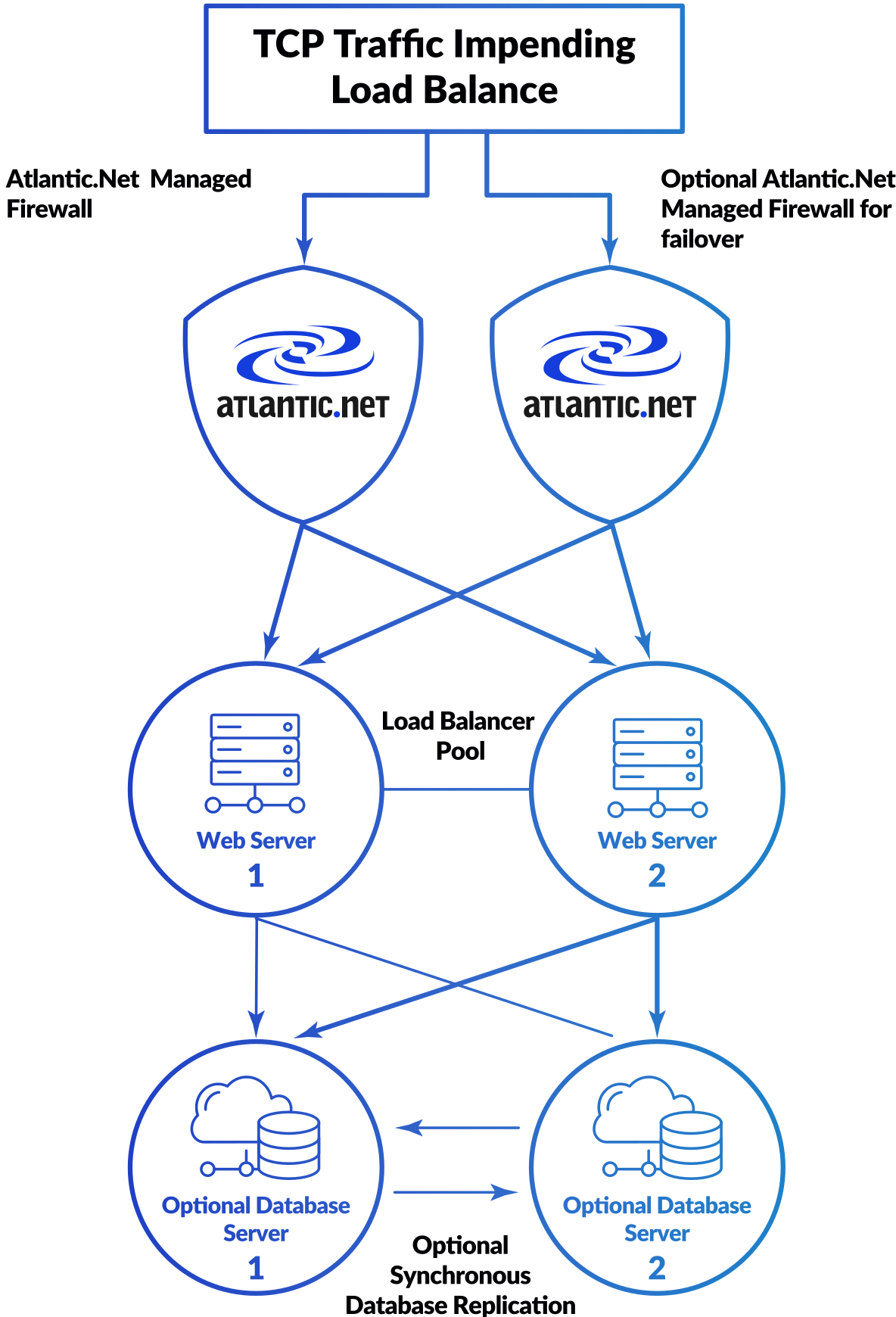
Load Balancing ‐ distribute incoming application traffic across multiple Atlantic.Net servers for an improved customer experience.

Ensure High Availability ‐ increase reliability, redundancy, and failover capability by sending requests only to healthy servers, providing continuity during unexpected outages.

Flexibility ‐ add or remove servers as demand changes ‐ perfect for clients with seasonal peaks or busy promotional periods.

Increase Scalability ‐ Atlantic.Net's Managed Load Balancing grows with your business. Whether you start small or scale aggressively, the service adapts.

Reduced Downtime ‐ during scheduled maintenance, live services stay online while individual servers are updated.

Increase Performance ‐ provide better response times to web services by distributing the workload.

TCP traffic distributed across the load balancer
Load Balancing algorithms

Load Balancing Algorithms

Atlantic.Net's Managed Firewall and Load Balancing service supports the load balancing algorithms most teams need:

  • Round Robin ‐ this simple algorithm sends incoming traffic to the next available server in the load-balancing cluster, in sequence (node 1, node 2, node 3, and so on).
  • Static Round Robin ‐ this method allocates a weighting or priority to a particular server, so incoming traffic is distributed to the preferred node(s) in the cluster when available.
  • Least Connections ‐ the load balancer tracks the number of open connections per server and sends each new request to the least busy server.
  • IP Source ‐ connections are distributed based on the source IP address. This is a great option for geolocation-aware load balancing. As long as the same set of servers is healthy, a given client IP always lands on the same server.
Load Balancing Features

Load Balancing Features

Atlantic.Net's Managed Firewall and Load Balancing service combines the most popular techniques in load-balancing technology, backed by the Atlantic.Net Firewall Service so you get security plus traffic distribution under one managed offering. For more information, email [email protected].

  • Sticky Sessions ‐ this efficiency feature keeps a user connected to the same web server for the duration of their session, avoiding the cost of re-opening session state on multiple servers and reducing overhead.
  • Health Checks ‐ the load balancer probes pool members for availability and health. Unhealthy nodes are flagged and bypassed until they recover.
  • SSL Termination ‐ SSL/TLS encryption is decoded on the load balancer before traffic reaches the web server. This improves performance and reduces the cryptographic workload on backend nodes.
  • Multi-Port Balancing ‐ this advanced technique routes traffic configured for a specific application port to one or more servers, giving application developers more performance flexibility.
  • Connection Throttling ‐ protects the load-balancing pool when specific incoming requests demand significant resources, preventing bandwidth-heavy applications from impacting the entire cluster.

Self-Hosted Load Balancer vs. Atlantic.Net Managed Load Balancing

What changes when you move from running your own HAProxy or Nginx load balancer to Atlantic.Net's Managed Load Balancing? The table below summarizes the differences most teams care about.

Capability Self-Hosted (HAProxy / Nginx) Atlantic.Net Managed Load Balancing
Setup, configuration, and hardening You Atlantic.Net engineers
Algorithms (Round Robin, Static RR, Least Connections, IP Source) Yes ‐ manual configuration Yes ‐ pre-configured and tunable
Sticky sessions Yes Yes
Health checks and automatic failover of unhealthy nodes Yes ‐ you tune intervals and thresholds Yes ‐ managed defaults
SSL/TLS termination Yes ‐ you manage certificate lifecycle Yes ‐ certificate handling included
Multi-port balancing and connection throttling Yes Yes
Integrated with managed firewall and DDoS mitigation No ‐ separate stack Yes ‐ same managed service
High availability of the load balancer itself You build the HA pair Yes ‐ HA included
24/7 monitoring of pool health You Atlantic.Net NOC, US-based
Compliance posture (SOC 2, HIPAA, PCI DSS) You Atlantic.Net audited environment
Time to deploy Days to weeks Hours

Ensure optimal application performance and reliability. Atlantic.Net's Managed Load Balancing delivers high availability and predictable scalability. Contact us to add resilience to your infrastructure. For faster application deployment, free IT architecture design, and assessment, call 888-618-DATA (3282) or email us at [email protected].

Frequently Asked Questions About Load Balancing

Load balancing is a technique that distributes incoming network traffic across a pool of servers so no single server is overloaded. The load balancer sits in front of the application fleet, decides which server should answer each request, and routes around servers that are unhealthy or saturated. The result is better performance, higher availability, and more predictable scaling under load.

Any application that needs to stay online during a server failure, scale beyond a single server's capacity, or absorb traffic spikes is a candidate for load balancing. Common drivers are seasonal peaks, marketing-driven traffic surges, regulatory uptime requirements, and the need to perform zero-downtime maintenance on individual servers.

Round Robin, Static (Weighted) Round Robin, Least Connections, and IP Source. Round Robin and Static Round Robin distribute by sequence and weight; Least Connections sends each new request to the least-busy server; IP Source pins traffic from a given client IP to a specific server, useful for geolocation-aware routing or session affinity at the network layer.

Round Robin distributes traffic by simple sequence regardless of how busy each server is, which is fine for short, similar requests but can overload a server stuck on a slow request. Least Connections looks at the actual open-connection count and routes to the least-loaded server, which handles long-lived or uneven workloads more gracefully.

Yes. SSL/TLS termination on the load balancer decrypts incoming HTTPS traffic before it reaches your backend servers. This centralizes certificate management and reduces the cryptographic workload on each web server, improving throughput. End-to-end encryption between the load balancer and backends is supported when policy requires it.

Sticky sessions (also called session affinity) keep a given user pinned to the same backend server for the duration of their session. They are useful for applications that store session state in local memory and cannot share that state across servers. Stateless applications ‐ those that store session data in a shared cache or database ‐ do not need sticky sessions and benefit from more even load distribution without them.

The load balancer continuously runs health checks against every server in the pool. When a server fails its check ‐ for example, no response on the configured port within the configured timeout ‐ it is taken out of rotation automatically and skipped until subsequent checks confirm it has recovered. Atlantic.Net's NOC is also alerted so engineers can investigate the underlying issue.

Yes. Servers can be added to or drained from the pool on request, which is what makes the service well suited to seasonal peaks, marketing launches, or rolling maintenance. Atlantic.Net engineers handle the change so existing sessions are not disrupted.

Yes. Managed Load Balancing is delivered alongside Atlantic.Net's Managed Firewall on the same FortiGate-based platform, so you get traffic distribution and perimeter security under a single managed contract, with one policy framework and one support relationship. GeoIP load balancing is also available via the Network Edge Protection service.

Pricing is based on the size of the load-balanced pool, the throughput required, and the bundled features (SSL termination, GeoIP, integration with Managed Firewall). Contact our sales team for a quote tailored to your environment.

Award-Winning Service

Award Winning Service

Millions of Cloud Deployments Worldwide

Trusted by Atlantic.Net

® Each logo is the registered trademark of its respective company.

Dedicated to Your Success

Jason Coleman, VP of Information Technology at Orlando Magic

"After evaluating a range of managed hosting options to support our data operations, we chose Atlantic.Net because of their superior infrastructure and extensive technical knowledge."

Erin Chapple, General Manager for Windows Server at Microsoft Corp.

"Atlantic.Net's support for Windows Server Containers in their cloud platform brings additional choice and options for our joint customers in search of flexible and innovative cloud services."

Form Icon

Share Your Vision With Us

And We Will Develop a Hosting Environment Tailored to Your Needs!

Contact an advisor at 866-618-DATA (3282), email [email protected], or fill out the form below.

Atlantic.Net
Privacy Overview

We use cookies for advertising, social media and analytics purposes. Read about how we use cookies in our updated Privacy Policy.

If you continue to use this site, you consent to our use of cookies and our Privacy Policy.