
DDoS mitigation
- Self-Managed Network Security
- Per-attack scrubbing fees or outages
- Atlantic.Net Network Edge Protection
- Always-on mitigation at the network edge
Filter attacks before they reach your servers with always-on DDoS mitigation, a managed ModSecurity WAF covering the OWASP Top 10, an included global CDN, and web optimization monitored 24/7/365 by Atlantic.Net's US-based NOC.
Monitoring & Response
24/7/365
DDoS Pricing
Fixed Price
Secure your valuable data with a managed Web Application Firewall, Content Delivery Network, and web optimization - all backed by always-on DDoS mitigation. Atlantic.Net's Managed Network Edge Protection lets you stay focused on your core business while our engineers absorb attacks, enforce policy, and accelerate delivery at the network perimeter.
What Is Network Edge Protection?
Network edge protection is a set of security and performance controls deployed at the network perimeter - the boundary between the public internet and your servers - to safeguard workloads against unauthorized access, DDoS attacks, application-layer abuse, and other cyber threats. The goal is to preserve the confidentiality, integrity, and availability of customer data while keeping legitimate traffic fast.
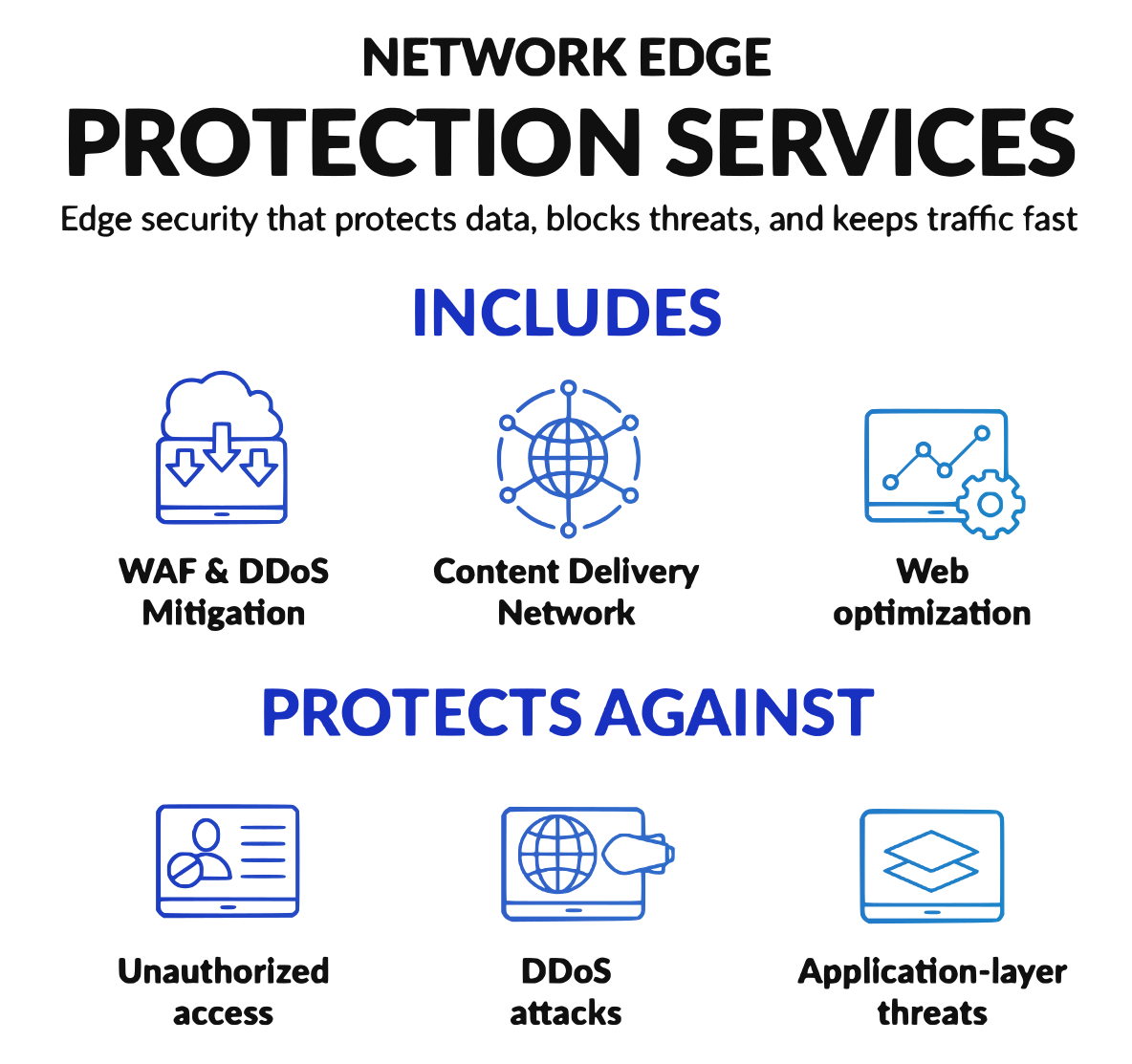
Denial-of-service (DoS) attacks interrupt an authorized user's access to a computer network. They have grown more frequent and more complex, including distributed (DDoS) and distributed reflector (DRDoS) variants - coordinated traffic floods from large botnets that make the source much harder to identify.
Modern attacks bypass traditional on-site defenses. Atlantic.Net's edge protection technology is designed to ensure that DDoS, DRDoS, and any service-denial traffic never reach your internet properties. The DDoS network is built to contain and repel advanced attacks - including UDP and ICMP floods, SYN/ACK abuse, DNS amplification, and Layer 7 application-layer attacks.
Atlantic.Net's DDoS protection pricing is fixed, so a traffic spike during an attack does not turn into an unpredictable bill. The primary objective is your safety and operational continuity.
Denial-of-service (DoS) attacks interrupt an authorized user's access to a computer network. They have grown more frequent and more complex, including distributed (DDoS) and distributed reflector (DRDoS) variants - coordinated traffic floods from large botnets that make the source much harder to identify.
Modern attacks bypass traditional on-site defenses. Atlantic.Net's edge protection technology is designed to ensure that DDoS, DRDoS, and any service-denial traffic never reach your internet properties. The DDoS network is built to contain and repel advanced attacks - including UDP and ICMP floods, SYN/ACK abuse, DNS amplification, and Layer 7 application-layer attacks.
Atlantic.Net's DDoS protection pricing is fixed, so a traffic spike during an attack does not turn into an unpredictable bill. The primary objective is your safety and operational continuity.
The integrated Web Application Firewall (WAF) inspects web traffic for suspicious activity and automatically filters out illegitimate requests based on rule sets that Atlantic.Net applies for you - or custom rules you can request. The WAF examines GET and POST-based HTTP requests and applies rules such as the ModSecurity core rule set covering the OWASP Top 10 vulnerabilities, deciding what to block, challenge, or let pass. It blocks comment spam, cross-site scripting (XSS), and SQL injection.
The WAF protects your internet property against attacks - including zero-day vulnerabilities - without compromising performance, while supporting PCI compliance requirements for online merchants. Coverage extends across the OWASP Top 10 plus custom rules for explicit attack patterns. Implementation does not require changes to your network architecture.
The integrated Web Application Firewall (WAF) inspects web traffic for suspicious activity and automatically filters out illegitimate requests based on rule sets that Atlantic.Net applies for you - or custom rules you can request. The WAF examines GET and POST-based HTTP requests and applies rules such as the ModSecurity core rule set covering the OWASP Top 10 vulnerabilities, deciding what to block, challenge, or let pass. It blocks comment spam, cross-site scripting (XSS), and SQL injection.
The WAF protects your internet property against attacks - including zero-day vulnerabilities - without compromising performance, while supporting PCI compliance requirements for online merchants. Coverage extends across the OWASP Top 10 plus custom rules for explicit attack patterns. Implementation does not require changes to your network architecture.
Web optimization streamlines content delivery by bundling JavaScript files, minimizing network connections, and compressing resource size to boost performance. Traffic is routed through the least-congested portions of our network.
The goal is to ensure that the various content types - including third-party resources embedded in your site - do not compromise loading time, regardless of the network or device used to access the content. The system automatically adapts presentation and delivery for different screen shapes and sizes while preserving speed and reliability for a seamless mobile experience.
Activating these services is fast, requires no code changes, and adds no hardware. Features include:
Automatic HTTPS rewrites - dynamically rewriting insecure URLs for both performance and security.
Automatic content caching - intelligently caching the objects required to render your site quickly.
Accelerated mobile links - drastically reducing mobile page-load time.
Automatic minification - removing unnecessary characters from HTML, CSS, and JavaScript.
Mix and match these features to take application performance to the next level.
Web optimization streamlines content delivery by bundling JavaScript files, minimizing network connections, and compressing resource size to boost performance. Traffic is routed through the least-congested portions of our network.
The goal is to ensure that the various content types - including third-party resources embedded in your site - do not compromise loading time, regardless of the network or device used to access the content. The system automatically adapts presentation and delivery for different screen shapes and sizes while preserving speed and reliability for a seamless mobile experience.
Activating these services is fast, requires no code changes, and adds no hardware. Features include:
Automatic HTTPS rewrites - dynamically rewriting insecure URLs for both performance and security.
Automatic content caching - intelligently caching the objects required to render your site quickly.
Accelerated mobile links - drastically reducing mobile page-load time.
Automatic minification - removing unnecessary characters from HTML, CSS, and JavaScript.
Mix and match these features to take application performance to the next level.
With servers positioned across key global points, Atlantic.Net's network delivers your content to customers with high speed and reliability. Lightweight infrastructure with integrated load balancing and built-in failover preserves performance while improving security. A smaller footprint translates to optimal use of power and cooling while preserving the integrity and seamless flow of your data.
As information travels, the CDN caches data and routes traffic by server proximity, so users reach your content quickly regardless of location. The system is easy to set up, with affordable and predictable pricing.
The platform is designed for the future. The network is continuously updated to integrate with emerging technologies. The mission is 100% uptime alongside access to state-of-the-art delivery solutions.
With servers positioned across key global points, Atlantic.Net's network delivers your content to customers with high speed and reliability. Lightweight infrastructure with integrated load balancing and built-in failover preserves performance while improving security. A smaller footprint translates to optimal use of power and cooling while preserving the integrity and seamless flow of your data.
As information travels, the CDN caches data and routes traffic by server proximity, so users reach your content quickly regardless of location. The system is easy to set up, with affordable and predictable pricing.
The platform is designed for the future. The network is continuously updated to integrate with emerging technologies. The mission is 100% uptime alongside access to state-of-the-art delivery solutions.
| Capability | Self-Managed Network Security | Atlantic.Net Network Edge Protection |
|---|---|---|
| DDoS mitigation | Per-attack scrubbing fees or outages | Always-on mitigation at the network edge |
| Coverage of advanced attacks (Layer 7, SYN/ACK, DNS amplification, DRDoS) | Often partial | Yes - designed against modern attack types |
| Web Application Firewall (OWASP Top 10) | Separate product, separate vendor | Built in - ModSecurity-based managed rule set |
| Custom WAF rules | Limited or self-built | Yes - configured and managed by Atlantic.Net |
| Content Delivery Network (CDN) | Separate vendor and contract | Built in |
| Web optimization (HTTPS rewrites, caching, minification) | Self-implemented | Built in, no code changes required |
| Pricing during a DDoS attack | Variable - subject to traffic-based spike billing | Fixed |
| 24/7 monitoring and response | You | Atlantic.Net NOC, US-based |
| Network architecture changes required | Usually yes - integrating multiple vendors | None - transparent at the edge |
| Compliance posture (PCI DSS) | You | Atlantic.Net audited environment |
| Time to deploy | Weeks to months for multi-vendor stack | Days |

® Each logo is the registered trademark of its respective company.

Jason Coleman
VP of Information Technology, Orlando Magic
"After evaluating a range of managed hosting options to support our data operations, we chose Atlantic.Net because of their superior infrastructure and extensive technical knowledge."

Joseph Nompleggi
VP of Product Development, Complete Healthcare Solutions
"As our reliable Healthcare IT compliance partner for the past ten years, Atlantic.Net continues to deliver advanced IT architectural design and security guidance and support to CHS. With their flexible, customized solutions and high touch approach, we look forward to continuing to grow and work with this distinguished team of professionals."

Gilad Shainer
Senior Vice President of Networking, NVIDIA
(Formerly Vice President of Market Development at Mellanox Technologies)
"Leveraging InfiniBand's performance, efficiency and scalability capabilities, Atlantic.Net is able to provide its customers with a high-performance, reliable and scalable on-demand public cloud hosting platform."

Erin Chapple
General Manager for Windows Server, Microsoft Corp.
"Atlantic.Net's support for Windows Server Containers in their cloud platform brings additional choice and options for our joint customers in search of flexible and innovative cloud services."

From single servers to fully managed clusters, we'll help you build the ideal infrastructure for your business.
Call or email us now.
Contact an advisor at 866-618-DATA (3282), email sales@atlantic.net, or fill out the form below to get started.

Recognized with the 2026 Excellence in Customer Service Award from the Business Intelligence Group, Atlantic.Net is committed to delivering industry-leading support and an exceptional customer experience.