Bare metal hosting illustration

Best Bare Metal Hosting Overview

There are three types of dedicated hosting offered by most managed service providers, giving businesses a wide choice when selecting the appropriate platform for their required workloads. They are bare metal hosting, dedicated cloud hosting, and shared cloud servers. Each model solves a different problem: raw performance, operational simplicity, or maximum flexibility.

Bare metal hosting is the best fit when you need maximum, consistent performance from a single-tenant physical server, especially for IO-intensive databases, GPU-accelerated AI/ML, real-time streaming, or ultra-low-latency workloads.

In these scenarios, the absence of a cloud hypervisor, direct access to hardware, and predictable resource isolation deliver better throughput and lower latency than a shared-hypervisor cloud server.

Managed dedicated hosting is more appropriate when you want similar performance but prefer the provider to handle OS, patching, backups, and monitoring. Cloud Servers are ideal when elastic scaling, managed services, and rapid experimentation matter more than absolute performance per node.

Why it matters: Choosing the right model affects not just speed, but how much control you have over kernels, drivers, and networking, as well as how predictable your monthly bill will be at steady load. Bare metal often wins on price/performance when utilization is high and relatively stable, while managed dedicated reduces operational burden at the cost of some control. Cloud servers tend to be more expensive at constant 24×7 utilization but pay off when workloads are bursty, experimental, or tightly integrated with higher-level services.
Bare metal vs managed dedicated vs cloud VMs overview graphic

Key Takeaways

Bare metal = maximum performance and control, but you own operations. Ideal for high IO, GPU, or low-latency workloads where you can justify heavier sysadmin investment.

Managed dedicated trades control for convenience and support. You still get single-tenant hardware, but the provider handles OS, patching, backups, and often monitoring

Cloud Servers win when elasticity and managed services are critical. Autoscaling, serverless components, and fully managed databases can offset server overhead in many application architectures.

Provisioning times differ significantly. Some bare metal SKUs can be delivered in minutes via automation, while custom builds may take hours or days; Cloud servers are deployed nearly instantly.

Hardware features such as GPUs, high-speed NICs, SR-IOV, and DPDK can be decisive for AI and real-time workloads These features are more predictable and tunable on bare metal than on highly abstracted cloud platforms.

Cost predictability favors bare metal and managed dedicated at steady load. Cloud is more variable: economical for short-lived or low-duty workloads, but often more expensive for 24×7 heavy usage.

Operational overhead is the main trade-off. The more control you want (custom drivers, non-standard OS choices), the more you move toward bare metal and away from fully managed cloud.

What Is Bare Metal Hosting?

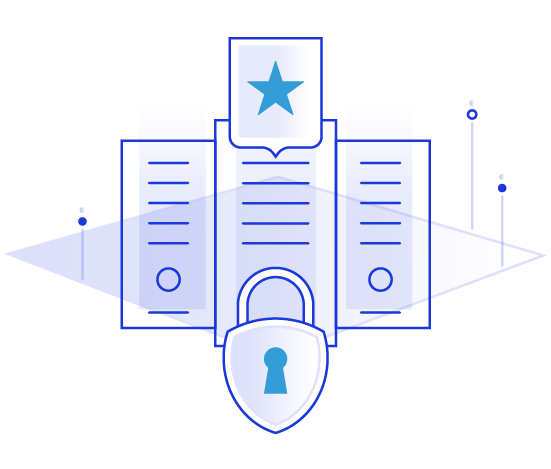
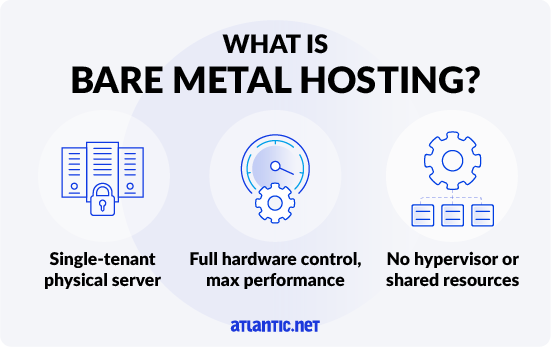
Bare metal hosting means renting a physical single-tenant server with no hypervisor layer embedded by the provider. You get direct access to the hardware (CPU, RAM, disks, NICs) and install your own operating system and stack. No other tenant shares that hardware, which helps eliminate noisy-neighbor issues and virtualization overhead for CPU, memory, and IO.

Managed dedicated hosting uses similar dedicated hardware but adds a service layer: the provider’s operations team takes on responsibilities such as OS installation, security patching, performance monitoring, backup orchestration, and incident response. You still benefit from customer-dedicated hardware, but you don’t need in-house experts for day-to-day administration. Cloud Servers sit at the other end of the spectrum. Virtual machines in public cloud share underlying hardware with other customers via a hypervisor. You gain instant provisioning, rich APIs, autoscaling, and access to a wide range of managed services, but you accept some performance overhead and less direct control over the physical layer.

Infographic explaining what bare metal hosting is

Benefits and Features of Bare Metal

Core Benefits

  • Performance: With no provider-managed hypervisor, workloads get direct access to CPU instructions, memory bandwidth, and storage, which is especially important for databases, analytics engines, and GPU workloads.
  • Kernel-level control: You can select and tune the exact OS, kernel version, and drivers you need, including real-time kernels, custom NUMA policies, and specialized GPU or NIC drivers.
  • Predictable latency: Dedicated hardware and consistent IO paths reduce jitter, making bare metal attractive for trading systems, real-time bidding, VoIP, and gaming backends
  • Isolation and security: Single-tenant systems minimize attack surface related to multi-tenant hypervisor exploits and side-channel issues, while simplifying certain compliance narratives (e.g., “no other customer shares the hardware”).
  • Cost efficiency at high utilization: When a node runs hot 24×7, the flat monthly pricing of bare metal often undercuts equivalent performance on per-hour cloud VMs.
Graphic showing benefits of bare metal hosting
Graphic showing technical features to look for in bare metal hosting

Technical Features to Look For

If you are in the market for bare metal hosting, it's important to understand the options available to you. It helps to focus on concrete capabilities rather than generic marketing terms:

  • Modern CPUs and GPUs:
    Recent CPU families (e.g., AMD EPYC, Intel Xeon Scalable) with high core counts and large caches; GPU SKUs such as NVIDIA L-series, H-series, or similar accelerators for AI, graphics, and scientific computing.
  • High-performance storage:
    NVMe SSDs for primary storage; optional RAID for redundancy; separate boot volumes; and explicit IOPS/throughput guarantees where possible.
  • Advanced networking:
    10–40 Gbit/s (or higher) NICs, with support for SR-IOV (Single Root I/O Virtualization) and DPDK (Data Plane Development Kit) for low-latency, high-throughput packet processing.
  • Out-of-band management:
    IPMI, Redfish, or similar interfaces for remote console access, power cycling, and PXE boot, enabling fully automated provisioning and recovery.
  • Automation and APIs:
    REST or CLI APIs for provisioning, reprovisioning, and lifecycle operations so you can integrate bare metal into Terraform, Ansible, or CI/CD workflows.

Comparing Service Types

The table below summarizes how bare metal, managed dedicated, and cloud VMs typically compare. Actual offerings vary, but these patterns are common and this should give you a good idea of what to expect.

Service type comparison: bare metal vs managed dedicated vs cloud VMs
Service Type Ideal For Isolation Scaling Performance Management Level Op Overhead Cost Predictability
Bare Metal High-IO databases, GPU/AI, low-latency trading, demanding game backends High Manual / Automated Highest Self-managed Medium High
Managed Dedicated Steady SaaS, regulated workloads, teams with small infra staff High Planned Very high Provider-managed Low–Medium High
Cloud (VM) Spiky workloads, experiments, dev/test, microservices with many dependencies Medium Elastic Good / Variable Provider-managed Low Variable
Summary: Bare metal prioritizes maximum performance and isolation with more operational effort; managed dedicated keeps high isolation while reducing day-to-day management; cloud VMs trade some isolation and predictability for elasticity and speed of provisioning.

Notes on practical differences:

Provisioning SLA icon

Provisioning SLAs:

Cloud VMs spin up in seconds. Bare metal ranges from “instant” pre-stocked SKUs to multi-day custom builds. Managed dedicated often sits in the middle, with standardized SKUs provisioned within hours.

GPU availability icon

GPU availability:

GPU bare metal can be capacity-constrained; popular accelerator models sell out quickly. Cloud offers fractional or spot GPUs, but with potentially higher hourly costs and preemption risk.

Support boundaries icon

Support boundaries:

Self-managed bare metal usually includes hardware support and network connectivity only; the OS and apps are your responsibility. Managed dedicated broadens the scope to OS and often middleware. Cloud VMs typically include platform reliability but not your guest OS configuration unless you buy managed add-ons.

Decision Paths by Scenario

Low Latency Database Transactions or Real-Time Bidding → Choose Bare Metal Hosting

Trading platforms, real-time bidding engines, and similar systems care about microseconds and jitter as much as raw throughput. Bare metal lets you pin cores, tune NIC queues, exploit SR-IOV/DPDK, and run custom kernels without the unpredictability of a shared hypervisor. Networking stacks and interrupt handling can be tuned aggressively, which is harder to achieve on generalized cloud infrastructure.

Graphic for choosing bare metal hosting
Graphic for choosing managed dedicated hosting

Steady SaaS with a Lean Operations Team → Choose Managed Dedicated

A subscription SaaS product with stable, 24×7 traffic often values reliability and predictable costs more than absolute peak performance. Managed dedicated hosting is a good fit here: you get single-tenant performance, but the provider’s team handles OS-level operations, patching, and backups. This model keeps the infrastructure footprint understandable without requiring you to build a full in-house SRE or platform team.

Unpredictable, Experiment-Heavy Workloads → Choose Cloud Servers

Early-stage products, experimentation with new architectures, or workloads tied to many managed services (queues, serverless, managed databases) tend to thrive in the cloud. Elastic scaling, regional diversity, and quick teardown give you optionality. Cloud servers are also ideal when you need to frequently recompose services, test different instance sizes, or integrate tightly with PaaS components.

Graphic for choosing cloud servers

Costs, Performance, and Risk Trade-Offs

Financially, bare metal and managed dedicated feel closer to capex-like commitments even when paid monthly. You usually commit to specific servers for at least one billing period, sometimes longer for discounted terms.

Technically, bare metal gives the best single-node performance and the most control over IO paths, but it demands more skills in automation, configuration management, and observability. You will likely invest in tools such as Terraform, Ansible, Prometheus, and centralized logging to get cloud-like operability.

Risk concentrates differently across models. With bare metal, hardware failures, misconfigurations, and slow redeploys are your primary risks, mitigated by redundancy and tested runbooks. In managed dedicated, you partially outsource that risk to the provider’s SLA and support processes. In cloud, you inherit platform risk (regional outages, noisy neighbors) but gain rapid failover and scale-out patterns, provided your architecture is designed for it.

Introducing Atlantic.Net Bare Metal & Managed Options

Atlantic.Net is a provider of Bare Metal hosting that implements the very latest high-performance hardware from Intel and AMD, with modern automation and U.S.-based 24/7 responsive support.

Our Bare Metal Hosting typically includes:

  • Rapid provisioning speed: Standard bare metal SKUs that can be delivered in minutes to a few hours via API, with clear SLAs for both standard and custom configurations.
  • GPU and NIC portfolios: GPU options suitable for training and inference, plus high-bandwidth NICs that support SR-IOV/DPDK for packet-intensive workloads such as firewalls, proxies, or real-time analytics.
  • Multiple service tiers: Atlantic.Net offers various service tiers to match our dedicated and bare metal hosting plans.
    • Self-managed bare metal for users that want full control.
    • Managed dedicated plans where Atlantic.Net handles OS patching, backups, and monitoring.
    • Optional advisory or professional services for migrations and performance tuning.
  • Global data centers: Facilities in strategically chosen metros to minimize latency to key markets, with options for private connectivity and compliance-aligned locations.
  • Compliance and security posture: Clear documentation for certifications, data handling, and segmentation, plus security-first defaults (e.g., restricted management interfaces, hardened base images).

How to Get Started with Atlantic.Net

Want to learn more about our Bare Metal Hosting platform? Take some time to consider your requirements and get in touch with our talent team to learn more.

Some important considerations should include:

  1. Workload profile icon

    1. Understand your workload profile →

    Identify whether you are optimizing for low latency, high throughput, GPU acceleration, or predictable SaaS-style traffic. Note any additional compliance needs or specific regions you would like to target.

  2. Choose service model icon

    2. Choose a service model →

    • Select Bare Metal if you want full control and have in-house expertise.
    • Choose Managed Dedicated if your team prefers to focus on the application layer.
  3. Select reference configuration icon

    3. Select a reference configuration →

    Use Atlantic.Net’s sizing guides to map required core counts, RAM, storage (NVMe/RAID), GPU requirements, and network bandwidth to recommended SKUs.

  4. Engage support icon

    4. Engage support and sales engineering →

    For new deployments, schedule a short architecture review or migration workshop. This ensures that choices around network design, IP addressing, and failover align with your uptime and compliance targets.

  5. Commit validated icon

    5. Commit once validated

    After a successful pilot, move to reserved or longer-term commitments where appropriate to lock in better price/performance.

Choosing between bare metal, managed dedicated, and cloud is ultimately about aligning your infrastructure with how your applications behave in the real world. If you run steady, performance-sensitive workloads or GPU-driven AI, bare metal and managed dedicated give you the control, predictability, and throughput that generalized cloud platforms often struggle to match.

Atlantic.Net can bridge that gap by pairing high-performance hardware with the right level of operational support, so your team can stay focused on the applications that drive your business.

Start a 30-day Pilot

on the Atlantic.Net Bare Metal and benchmark real performance, not just spec sheets.

Our Technology Partners

Technology Partners
® Each logo is the registered trademark of its respective company.

In The News

In The News Logo Grid

Our Data Center Certifications

Database Certifications

Award-Winning Service

Award Winning Service

Millions of Cloud Deployments Worldwide

Trusted by Atlantic.Net

® Each logo is the registered trademark of its respective company.

Dedicated to Your Success

Jason Profile Picture

- Jason Coleman

VP of Information Technology, Orlando Magic

"After evaluating a range of managed hosting options to support our data operations, we chose Atlantic.Net because of their superior infrastructure and extensive technical knowledge."

Erin Profile Picture

- Erin Chapple

General Manager for Windows Server, Microsoft Corp.

"Atlantic.Net’s support for Windows Server Containers in their cloud platform brings additional choice and options for our joint customers in search of flexible and innovative cloud services."

Form Icon

Share Your Vision With Us

And We Will Develop a Hosting Environment Tailored to Your Needs!

Contact an advisor at 866-618-DATA (3282), email [email protected], or fill out the form below.

Atlantic.Net
Privacy Overview

We use cookies for advertising, social media and analytics purposes. Read about how we use cookies in our updated Privacy Policy.

If you continue to use this site, you consent to our use of cookies and our Privacy Policy.