A bare metal server is a single-tenant physical server you rent for your exclusive use. You get direct access to dedicated CPU, memory, storage, and networking or GPU without sharing resources with other customers.
There is typically no preinstalled hypervisor, so you choose the operating system and can run your own virtualization stack if you want. Bare metal is a strong fit when you need predictable performance, low latency, specific hardware, or strict isolation for sensitive workloads. The tradeoff is simpler scaling and more operational responsibility compared to virtual servers.
Bare Metal vs. Virtual Machines (VM)
| What you need | Bare Metal Server | Cloud Server / VM | Shared Cloud Resources | Dedicated Host (provider-managed) |
| Tenant isolation | Single tenant | Isolated VMs on shared hardware | Shared platform/service | Single tenant (often with platform tooling) |
| Virtualization layer | Not required; you can add your own | Hypervisor-managed | Abstracted away | Typically included/managed by the provider |
| Performance consistency | Highest consistency (no “noisy neighbor”) | Can vary by host contention | Varies by service and tier | High; depends on platform design |
| Scaling | Hardware changes take planning | Fast resize/scale | Fast scale within service limits | Often faster than classic dedicated |
| Control over OS + stack | Full control | High, but within VM limits | Limited (service-managed) | High, with provider constraints |
| Best fit | Steady-state, performance-sensitive workloads | General workloads, dev/test, elastic apps | SaaS, managed storage, managed platforms | Teams wanting dedicated hardware plus platform convenience |
| Ops responsibility | Highest (unless managed) | Medium | Lowest | Medium (shared responsibility) |
What is a Bare Metal Server?
A bare metal server is a physical machine assigned to a single customer, ensuring you never share CPU cores, RAM, disks, or GPU interfaces with other tenants. While “bare metal” and “dedicated server” are often used interchangeably, the primary difference lies in the delivery model.
Traditional dedicated servers typically involve manual provisioning and fixed contracts. In contrast, modern bare metal offers a “cloud-like” experience, featuring automated deployment, rapid provisioning, and flexible billing—all while maintaining the performance of a dedicated environment.
How Does a Bare Metal Server Work?
In a bare metal environment, the operating system (OS) is installed directly on the server’s hard drive. There are no intermediate layers. This contrasts with virtualization, where a hypervisor creates multiple “guest” machines on a single physical host.
Since there is no hypervisor, the operating system can communicate directly with the underlying hardware components. This direct access allows for:
- Instruction execution: The CPU executes instructions without translation layers.
- Memory access: Applications utilize RAM without fighting for allocation.
- I/O throughput: Storage controllers deliver raw speed directly to the database or application.
Why is it called “Bare Metal”?
“Bare metal” describes a deployment where the operating system runs directly on a physical server and schedules CPU time and manages memory without a host hypervisor (Type-1 or Type-2), abstracting the hardware into virtual machines. The kernel talks straight to the platform via native drivers and standard firmware interfaces (BIOS/UEFI, ACPI), with direct access to CPU features (including virtualization extensions if present), PCIe devices, storage controllers, and NICs.
In practical terms, you get exclusive control of the machine’s hardware resources and topology—NUMA layout, CPU pinning/isolcpus, huge pages, SR-IOV/NVMe device passthrough, IRQ affinity, etc.—because there’s no virtualization layer mediating or time-slicing those resources into VM constructs.
Benefits of Bare Metal Servers
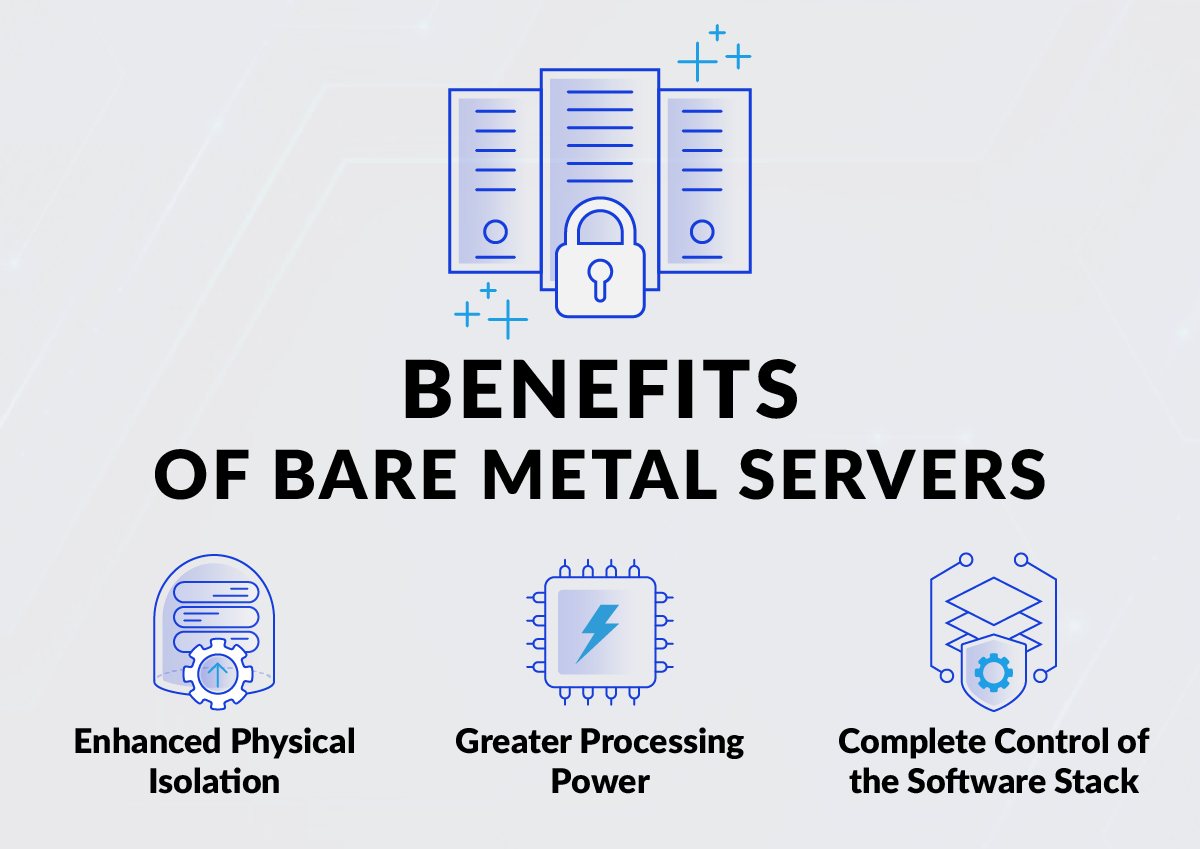
Enhanced Physical Isolation
Bare metal gives you physical separation from other tenants. This helps when you want to reduce cross-tenant risk, avoid resource contention, and keep sensitive workloads in a single-tenant environment.
Where isolation matters most:
- Regulated data handling: Ideal for privacy, healthcare, and payments.
- Internal systems: Best for systems with strict access boundaries.
- Risk mitigation: Useful for workloads where performance variability creates business risk.
Greater Processing Power
Dedicated hardware allows you to avoid common multi-tenant issues like contention and jitter.
This is essential when you have:
- Sustained CPU-bound workloads
- Storage-heavy workloads (high IOPS, low-latency I/O)
- Network-sensitive workloads (consistent throughput and latency)
Complete Control of the Software Stack
You control the OS, kernel settings, drivers, agents, and security tooling.
This layer of control is useful when you need:
- A specific OS image or hardened baseline
- Custom libraries and dependencies
- Specialized runtime settings (CPU pinning, hugepages, tuned networking)
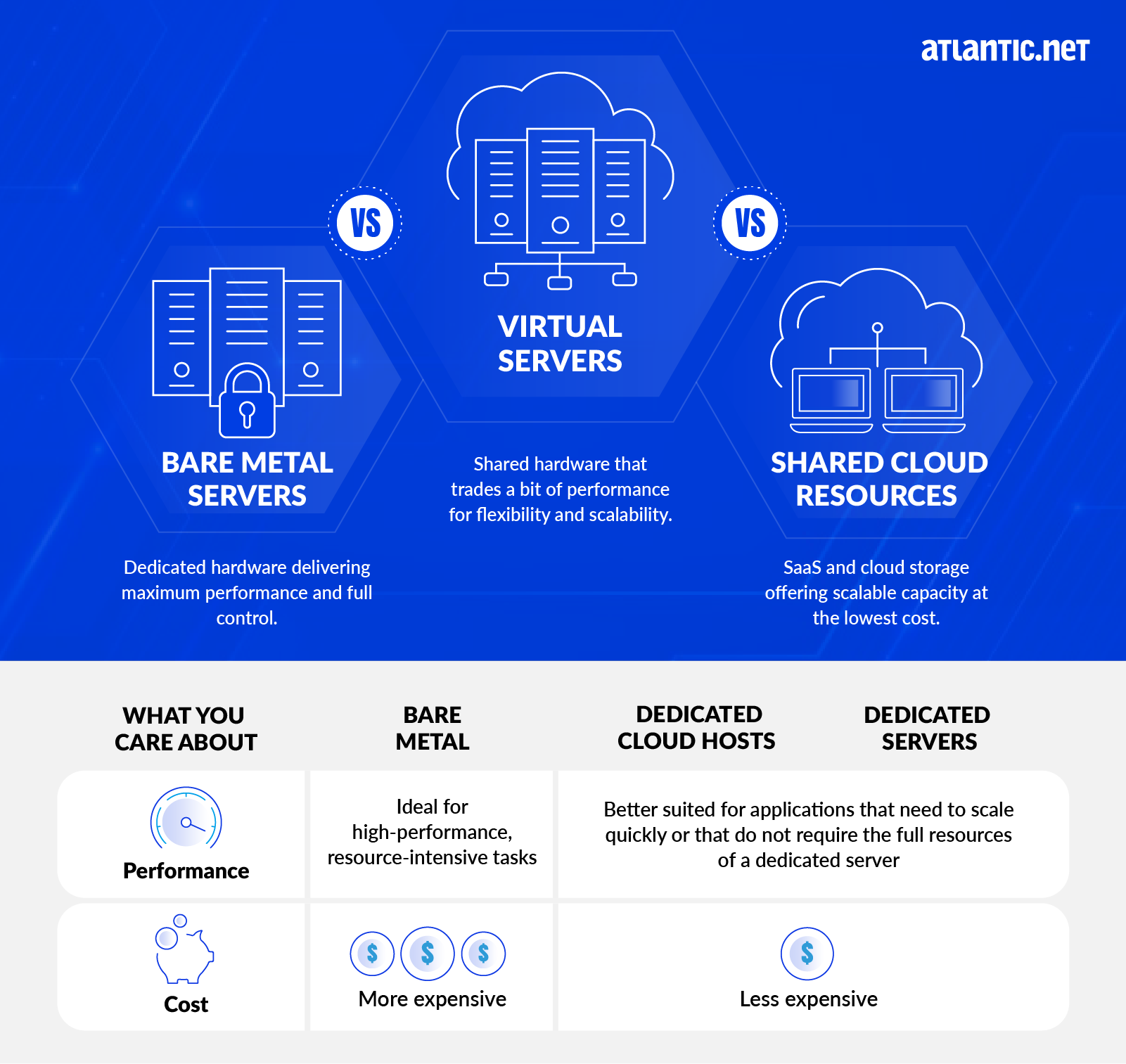
Bare Metal Servers vs. Virtual Servers vs. Shared Cloud Resources
These options solve different problems:
- Bare metal: dedicated hardware for predictable performance and full control
- Virtual servers (Cloud Server/VMs): a dedicated slice of a shared host; easier scaling and faster provisioning
- Shared cloud resources: managed services (storage, SaaS, databases) that trade control for speed and simplicity
A simple decision rule:
- Choose bare metal when performance, isolation, or hardware control is required.
- Choose Cloud Server/VM when you want flexibility and fast change with acceptable performance variance.
- Choose shared cloud services when you want the provider to handle the platform layer.
Top Use Cases for Bare Metal in 2026
Artificial Intelligence (AI) and Machine Learning (ML)
Training Large Language Models (LLMs) and running inference requires massive parallel processing power. Bare metal servers equipped with high-performance GPUs allow AI workloads to run without the latency or virtualization taxes found in public cloud instances.
Big Data and High-Performance Computing (HPC)
Processing terabytes of data requires high Input/Output Operations Per Second (IOPS). Bare metal servers maximize disk I/O, making them ideal for:
- Hadoop and Spark clusters.
- Scientific modeling and simulations.
- Genomic sequencing.
Fintech and Banking
Financial institutions require microsecond latency for high-frequency trading. The variable latency of a virtualized environment is often unacceptable. Bare metal ensures consistent execution speeds and meets strict regulatory data residency requirements.
Healthcare (HIPAA Compliant Hosting)
Healthcare providers often choose bare metal to ensure strict physical separation of Electronic Health Records (EHR). Dedicated environments simplify the auditing process for HIPAA compliance by eliminating the complexity of shared responsibility in multi-tenant clouds.
Bare Metal vs. Dedicated Servers: Is There a Difference?
In 2026, the terms are often used interchangeably, but there is a nuance:
- Dedicated Servers traditionally referred to physical boxes leased on monthly or yearly contracts, often with manual provisioning times (hours or days).
- Bare Metal Cloud often refers to the same physical hardware but with cloud-like automation—provisioned in minutes via API, with hourly or monthly billing.
Functionally, both provide the same single-tenant performance benefits.
Best Practices for Managing Bare Metal Servers
Maintain and Upgrade Hardware
Bare metal is physical infrastructure. Treat it like it:
- Track lifecycle and warranties (where relevant)
- Plan for component failure (drives, fans, power)
- Schedule maintenance windows for firmware and hardware work
Optimize Security Measures
Start with a clear baseline, then enforce it:
- Least privilege and role-based access
- MFA for administrative access
- Patch OS and applications on a defined schedule – atleast monthly.
- Encrypt data at rest and in transit where appropriate
- Centralize logs and protect log integrity
Manage Network Configurations and Traffic
Network choices show up as user experience:
- Segment networks for admin, app, and data paths
- Use firewalls and allow-listing for exposed ports
- Add DDoS protections and rate limits where needed
- Monitor for anomalies (unexpected egress, scanning, spikes)
Monitor Performance for Optimization Opportunities
A bare metal server won’t tell you it’s struggling unless you watch:
- CPU saturation and load patterns
- Memory pressure and swapping
- Disk latency, IOPS, and queue depth
- Network throughput, packet loss, and latency
- Application-level indicators (p95/p99 latency, error rates)
Ensure Compliance and Auditing
If compliance is part of your reason for choosing bare metal, operational proof matters:
- Keep access logs and change records
- Document security baselines and exceptions
- Run periodic configuration reviews and vulnerability checks
- Validate backup/restore procedures with real tests
Atlantic.Net Bare Metal Dedicated Server Hosting
At Atlantic.Net, we offer single-tenant bare metal servers designed for customers who want direct control of the OS and application stack. You can choose from our preset configurations or request custom builds, depending on workload needs. Our storage options and redundancy choices are part of the configuration process, and we often pair bare metal with monitoring, backups, and security controls based on how you operate the environment.
We provide a stable foundation for your private cloud. If you’re running both bare metal and cloud resources, our common approach is to keep steady-state, performance-sensitive workloads on bare metal and use our cloud instances for burst capacity..
Advantages of Bare Metal Hosting
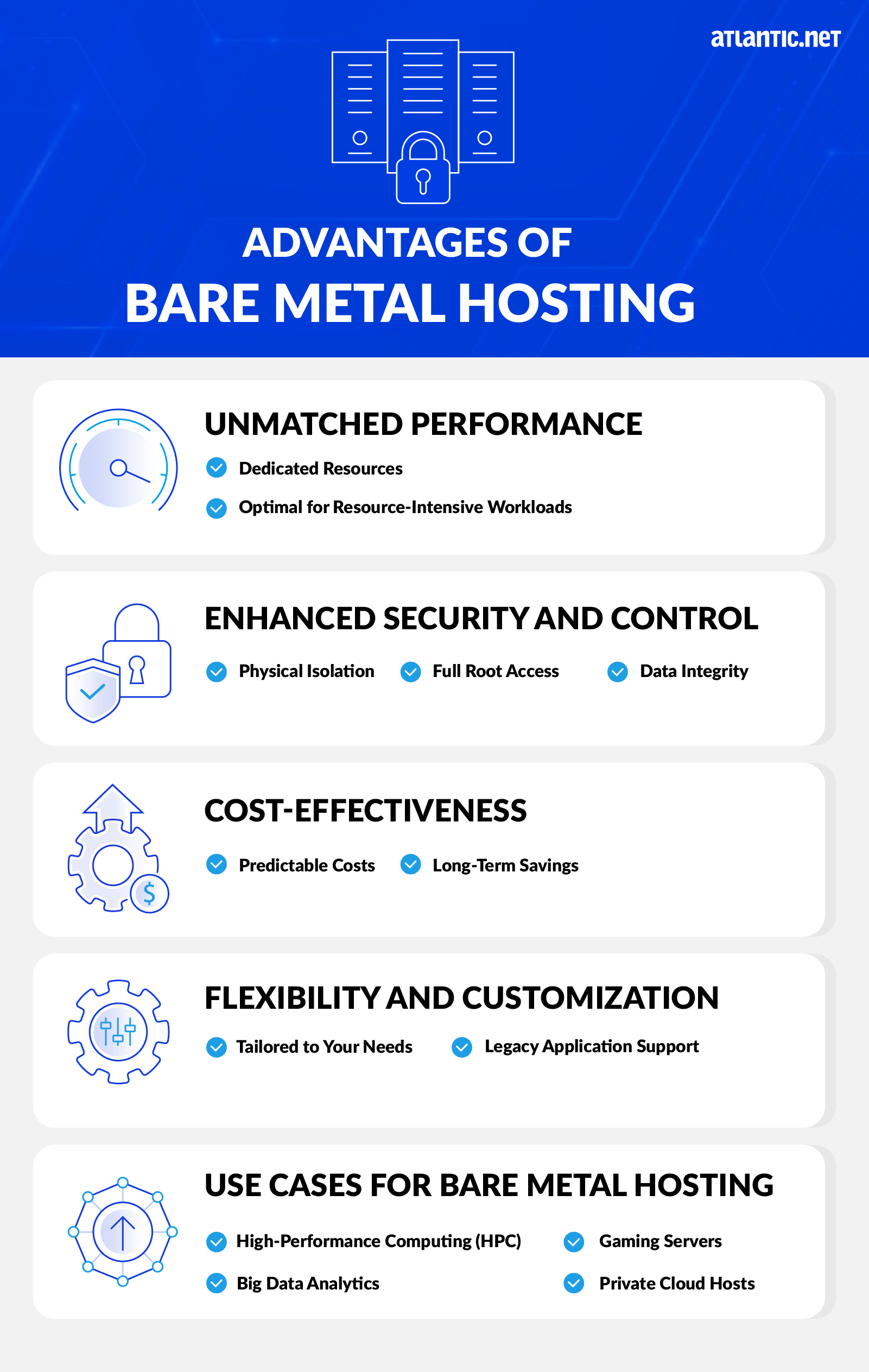
Bare metal hosting is most compelling when you need a combination of:
- Predictable performance for steady workloads
- Physical isolation for sensitive systems
- Full administrative control over the OS and software stack
- Hardware choice aligned to your workload (compute, storage, network)
- A stable foundation for private cloud and specialized platforms
FAQ
What’s the difference between bare metal and a dedicated server?
In many contexts, they refer to the same thing: single-tenant physical hardware. When providers separate the terms, “bare metal” often implies faster provisioning and more automation, while “dedicated server” can imply a more traditional lease model.
Is bare metal more secure than a Cloud Server or VM?
It can reduce certain multi-tenant risks because the hardware is not shared. Security still depends on how you configure access, patching, monitoring, encryption, and incident response.
Can I run virtualization (VMware, Hyper-V, KVM, Proxmox) on bare metal?
Yes. Many teams use bare metal as the base layer and run their own hypervisor and VM templates on top. That’s a common pattern for private cloud and controlled multi-workload environments.
When should I choose bare metal instead of shared cloud resources?
Choose bare metal when you need stable performance, specific hardware, or tighter control over the stack. Choose shared services when speed, managed operations, and rapid scaling matter more than low-level control.
What are the most common bare metal mistakes?
Underestimating ongoing operations is the big one. Teams often forget to plan for patching, monitoring, backups, on-call response, and maintenance windows until something breaks.
How do I choose the right bare metal configuration?
Start with your bottleneck: CPU, RAM, storage latency, or network. Use current telemetry (or load tests) to size the server, then add headroom for growth and failure scenarios.
Can I connect bare metal to a cloud environment?
Often, yes. Many providers support hybrid patterns where bare metal runs the steady core workload and cloud resources handle burst, testing, or supporting services. The best approach depends on networking, security boundaries, and how you manage identity and access.
Is bare metal always more expensive?
Not always. For steady workloads that run 24/7, bare metal can be cost-competitive because you’re paying for dedicated capacity. For bursty workloads, virtual servers and managed services can be cheaper because you scale down when you don’t need resources.
See Additional Guides on Key Hybrid Cloud Topics
Together with our content partners, we have authored in-depth guides on several other topics that can also be useful as you explore the world of hybrid cloud.
Colocation Hosting
Authored by Atlantic.Net
- [Guide] What is Colocation Hosting in 2025? Benefits of Colocation Hosting
- [Guide] Finding the Best Colocation Facility: What to Consider
- [Blog] How to Secure SSH Server on Arch Linux
- [Product] Atlantic.Net Cloud Platform | Scalable, Secure Cloud Solutions
Related Products:

Written by
Gilad David Maayan is a technology writer who has worked with over 150 technology companies including SAP, Imperva, Samsung NEXT, NetApp and Check Point, producing technical and thought leadership content that elucidates technical solutions for developers and IT leadership. Today he heads Agile SEO, the leading marketing agency in the technology industry.