Dedicated Linux Server 1
- CPU
- 6-core Intel Xeon E-2236
- RAM
- 64 GB
- Storage
- 2 × 480 GB SSD RAID 1
- Price
- $139/mo
Run your workload on an entire physical server with dedicated CPU, RAM, storage, and bandwidth, your choice of Linux distributions, no setup fees, and 24/7/365 US-based support.

Dedicated Configurations
6
Plans Start At
$139/mo
Your applications deserve more than a shared slice of a server. Atlantic.Net Linux dedicated hosting gives you a physical server to yourself, full root access, and a choice of Linux distributions, backed by a triple 100% SLA covering network uptime, hardware replacement, and infrastructure availability.
Plans start at $139 per month with no setup fees. US-based support answers the phone 24/7/365.
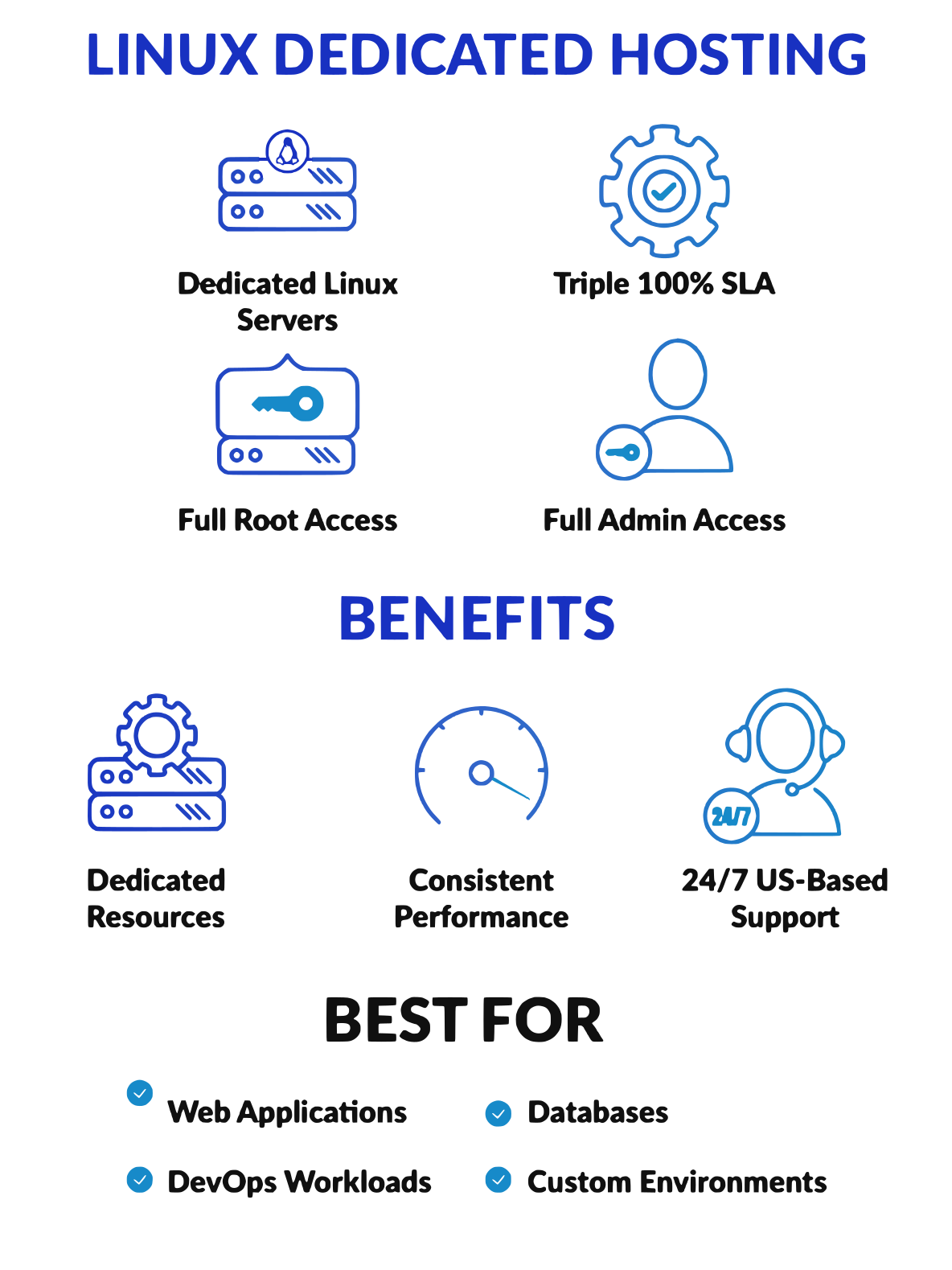
Linux dedicated hosting is a web hosting service in which you rent an entire physical server running Linux. Unlike shared hosting, where many customers share the same server resources, a dedicated server reserves all CPU cores, RAM, storage, and bandwidth for your use alone.
You get full root access to the server, meaning you can install any software, configure the operating system as you see fit, load any Linux distribution, and set custom configurations that shared web hosting providers simply cannot offer. The hosting provider owns and maintains the physical hardware, while you control everything above the operating system level.
This model suits businesses and developers who need consistent computing power, resource-intensive applications, and complete freedom over their server environment.
Atlantic.Net offers six dedicated server plans. All include 20TB monthly outbound transfer, a 1Gbps port, and no setup fees. Longer billing terms reduce the price by up to 30%.
Server 6 pairs AMD EPYC processors with NVMe storage for workloads that demand the highest sequential read and write throughput. Custom builds are also available if none of these configurations match your exact requirements.
All RAID configurations protect against drive failure without interrupting your server. RAID1 mirrors data across two drives; RAID10 combines mirroring and striping across four drives for both redundancy and performance.
| Plan | CPU | RAM | Storage | Price |
|---|---|---|---|---|
| Dedicated Linux Server 1 | 6-core Intel Xeon E-2236 | 64 GB | 2 × 480 GB SSD RAID 1 | $139/mo |
| Dedicated Linux Server 2 | 12-core dual Intel Xeon E5-2620 v3 | 64 GB | 2 × 960 GB SSD RAID 1 | $189/mo |
| Dedicated Linux Server 3 | 36-core dual Intel Xeon Gold 6140 | 128 GB | 4 × 1.92 TB SSD RAID 10 | $495/mo |
| Dedicated Linux Server 4 | 36-core dual Intel Xeon Gold 6140 | 256 GB | 4 × 1.92 TB SSD RAID 10 | $599/mo |
| Dedicated Linux Server 5 | 36-core dual Intel Xeon Gold 6140 | 256 GB | 4 × 3.84 TB SSD RAID 10 | $699/mo |
| Dedicated Linux Server 6 | 64-core AMD EPYC 7702P | 128 GB | 2 × 960 GB NVMe SSD | $709/mo |
Atlantic.Net supports the most widely used Linux distributions. Your choice of operating system costs nothing extra, and custom OS configurations are available on request.
Ubuntu is the most popular Linux distribution for server hosting globally. It ships with five years of long-term support on LTS releases, an enormous package repository, and excellent documentation. It suits web servers, application servers, and developer workstations equally well. If you are new to Linux dedicated server hosting, Ubuntu is the most straightforward starting point.
Ubuntu is the most popular Linux distribution for server hosting globally. It ships with five years of long-term support on LTS releases, an enormous package repository, and excellent documentation. It suits web servers, application servers, and developer workstations equally well. If you are new to Linux dedicated server hosting, Ubuntu is the most straightforward starting point.
CentOS has a long history as a stable, enterprise-grade Linux server distribution derived from Red Hat Enterprise Linux source code. Many sysadmins chose it for its predictable release cycle and close compatibility with RHEL tooling. Atlantic.Net continues to support CentOS on dedicated servers for teams with existing CentOS environments.
CentOS has a long history as a stable, enterprise-grade Linux server distribution derived from Red Hat Enterprise Linux source code. Many sysadmins chose it for its predictable release cycle and close compatibility with RHEL tooling. Atlantic.Net continues to support CentOS on dedicated servers for teams with existing CentOS environments.
Rocky Linux was built specifically to fill the gap left by CentOS's shift in model. It delivers full binary compatibility with Red Hat Enterprise Linux, making it the natural migration path for former CentOS users. Rocky Linux suits mission-critical workloads that need long-term stability and RHEL-compatible package management.
Rocky Linux was built specifically to fill the gap left by CentOS's shift in model. It delivers full binary compatibility with Red Hat Enterprise Linux, making it the natural migration path for former CentOS users. Rocky Linux suits mission-critical workloads that need long-term stability and RHEL-compatible package management.
Fedora Linux runs closer to the leading edge of the Linux ecosystem than most distributions. Red Hat sponsors its development, and it frequently previews features that later appear in RHEL. Choose Fedora Linux when you want access to the latest kernel versions and software packages without waiting for a slower release cycle.
Fedora Linux runs closer to the leading edge of the Linux ecosystem than most distributions. Red Hat sponsors its development, and it frequently previews features that later appear in RHEL. Choose Fedora Linux when you want access to the latest kernel versions and software packages without waiting for a slower release cycle.
Debian is one of the oldest and most respected Linux distributions. Its package management is thorough, its releases are conservative, and its community is enormous. Debian underpins Ubuntu and dozens of other distributions. It works particularly well for servers that need to run for years without major disruptions.
Debian is one of the oldest and most respected Linux distributions. Its package management is thorough, its releases are conservative, and its community is enormous. Debian underpins Ubuntu and dozens of other distributions. It works particularly well for servers that need to run for years without major disruptions.
Arch Linux follows a rolling release model, meaning your system updates continuously rather than jumping between major versions. It gives you a minimal base to build from, with complete freedom to install only what you need. Arch Linux suits experienced administrators who want precise control over every package on their server.
Arch Linux follows a rolling release model, meaning your system updates continuously rather than jumping between major versions. It gives you a minimal base to build from, with complete freedom to install only what you need. Arch Linux suits experienced administrators who want precise control over every package on their server.
Red Hat Enterprise Linux is available to teams that require direct Red Hat commercial support, along with access to the RHEL ecosystem of certified software and compliance tooling. RHEL is a strong choice for regulated industries and enterprises with existing Red Hat relationships.
Red Hat Enterprise Linux is available to teams that require direct Red Hat commercial support, along with access to the RHEL ecosystem of certified software and compliance tooling. RHEL is a strong choice for regulated industries and enterprises with existing Red Hat relationships.
Every Atlantic.Net Linux dedicated server ships with full root access enabled. You can install any package, compile software from open source code, configure networking, run virtual machines, or modify the kernel. Shared hosting providers limit what you can install and how you can configure the server. A dedicated server removes those limits entirely.
Every Atlantic.Net Linux dedicated server ships with full root access enabled. You can install any package, compile software from open source code, configure networking, run virtual machines, or modify the kernel. Shared hosting providers limit what you can install and how you can configure the server. A dedicated server removes those limits entirely.
On shared hosting, other tenants consume CPU cycles, RAM, and disk I/O that directly affect your application. A dedicated server is yours. High-traffic spikes from another customer never slow down your application. Your database queries run against dedicated resources, not a shared queue used by dozens of other sites.
On shared hosting, other tenants consume CPU cycles, RAM, and disk I/O that directly affect your application. A dedicated server is yours. High-traffic spikes from another customer never slow down your application. Your database queries run against dedicated resources, not a shared queue used by dozens of other sites.
Dedicated servers deliver consistent performance because you are not competing for resources. High-performance applications that need low-latency responses benefit directly from this predictability. You know exactly how much CPU and RAM are available, and you can tune the Linux operating system to extract full performance from the hardware.
Dedicated servers deliver consistent performance because you are not competing for resources. High-performance applications that need low-latency responses benefit directly from this predictability. You know exactly how much CPU and RAM are available, and you can tune the Linux operating system to extract full performance from the hardware.
Shared hosting looks cheap until you factor in the performance ceiling, the restrictions on what you can run, and the cost of downtime. For high-traffic applications and resource-intensive workloads, a dedicated server is a cost-effective choice because you pay for capacity you fully use rather than sharing capacity you never fully use. Plans start at $139 per month, and longer billing terms bring costs down further.
Shared hosting looks cheap until you factor in the performance ceiling, the restrictions on what you can run, and the cost of downtime. For high-traffic applications and resource-intensive workloads, a dedicated server is a cost-effective choice because you pay for capacity you fully use rather than sharing capacity you never fully use. Plans start at $139 per month, and longer billing terms bring costs down further.
Linux dedicated hosting gives you access to a range of mature operating systems. Popular Linux distributions like Ubuntu, Debian, Rocky Linux, Fedora Linux, Arch Linux, and CentOS all run well on dedicated hardware. You are not locked into a single vendor's stack, and you can run different distributions on different servers to match the needs of each workload.
Linux dedicated hosting gives you access to a range of mature operating systems. Popular Linux distributions like Ubuntu, Debian, Rocky Linux, Fedora Linux, Arch Linux, and CentOS all run well on dedicated hardware. You are not locked into a single vendor's stack, and you can run different distributions on different servers to match the needs of each workload.
Atlantic.Net holds SOC 2 Type II, SOC 3 Type II, HIPAA, HITECH, and PCI-ready certifications across its data center network. If your application handles healthcare records, payment data, or other regulated information, you can build on infrastructure that has already been audited.
Atlantic.Net holds SOC 2 Type II, SOC 3 Type II, HIPAA, HITECH, and PCI-ready certifications across its data center network. If your application handles healthcare records, payment data, or other regulated information, you can build on infrastructure that has already been audited.
Switching hosting providers is disruptive. Atlantic.Net provides free migration assistance to reduce the time and risk of migrating your workloads to a new dedicated server. The support team handles the technical side, and you keep the downtime window as short as possible.
Switching hosting providers is disruptive. Atlantic.Net provides free migration assistance to reduce the time and risk of migrating your workloads to a new dedicated server. The support team handles the technical side, and you keep the downtime window as short as possible.
A Linux dedicated server handles far more web traffic than shared hosting providers can support on a shared environment. You run your own web server configuration, set your own connection limits, and deploy custom caching layers. For agencies managing dozens of client sites or publishers handling millions of monthly page views, dedicated server hosting provides the throughput and the control that shared hosting cannot.
Linux server hosting providers also support load balancers as managed add-ons, letting you spread traffic across multiple servers as your audience grows. Dedicated IP addresses simplify SSL certificate management and improve email deliverability.
A Linux dedicated server handles far more web traffic than shared hosting providers can support on a shared environment. You run your own web server configuration, set your own connection limits, and deploy custom caching layers. For agencies managing dozens of client sites or publishers handling millions of monthly page views, dedicated server hosting provides the throughput and the control that shared hosting cannot.
Linux server hosting providers also support load balancers as managed add-ons, letting you spread traffic across multiple servers as your audience grows. Dedicated IP addresses simplify SSL certificate management and improve email deliverability.
Game servers demand consistent low-latency responses and the ability to handle sudden spikes in concurrent connections. A Linux dedicated server gives you the raw computing power to run popular game server software, configure tick rates, install mods, and manage multiple game instances. Atlantic.Net operates five US data centers, so you can place your game server close to your player base and reduce latency for everyone in the match.
Game servers demand consistent low-latency responses and the ability to handle sudden spikes in concurrent connections. A Linux dedicated server gives you the raw computing power to run popular game server software, configure tick rates, install mods, and manage multiple game instances. Atlantic.Net operates five US data centers, so you can place your game server close to your player base and reduce latency for everyone in the match.
An online store cannot afford downtime. Payment processing, inventory management, and checkout flows are all mission-critical workloads where even a few minutes of unavailability cost real revenue. Linux dedicated hosting with RAID storage protects against drive failure, the triple 100% SLA covers hardware replacement, and the compliance certifications mean you can meet PCI requirements without building your own audit program.
An online store cannot afford downtime. Payment processing, inventory management, and checkout flows are all mission-critical workloads where even a few minutes of unavailability cost real revenue. Linux dedicated hosting with RAID storage protects against drive failure, the triple 100% SLA covers hardware replacement, and the compliance certifications mean you can meet PCI requirements without building your own audit program.
APIs, SaaS platforms, and content delivery all generate high traffic patterns that benefit from dedicated resources. You control the server, so you can tune the Linux operating system, configure connection pools, and optimize the network stack for your specific access patterns. When your application needs more capacity, you scale to a higher-tier server or add managed load balancers rather than waiting for a shared hosting provider to lift a resource cap.
APIs, SaaS platforms, and content delivery all generate high traffic patterns that benefit from dedicated resources. You control the server, so you can tune the Linux operating system, configure connection pools, and optimize the network stack for your specific access patterns. When your application needs more capacity, you scale to a higher-tier server or add managed load balancers rather than waiting for a shared hosting provider to lift a resource cap.
Databases, analytics pipelines, and real-time data processing all qualify as mission-critical workloads where uninterrupted operation matters more than initial cost. A dedicated server with NVMe storage handles intensive read/write operations without the I/O contention you see on virtual machines in shared environments. The AMD EPYC 7702P plan, with 64 cores and NVMe storage, suits the most demanding workloads on the list.
Databases, analytics pipelines, and real-time data processing all qualify as mission-critical workloads where uninterrupted operation matters more than initial cost. A dedicated server with NVMe storage handles intensive read/write operations without the I/O contention you see on virtual machines in shared environments. The AMD EPYC 7702P plan, with 64 cores and NVMe storage, suits the most demanding workloads on the list.
Atlantic.Net includes a managed Security Firewall as an add-on, along with IDS (intrusion detection), DDoS protection, a Web Application Firewall, and CDN integration. DDoS attacks are a constant threat to publicly accessible servers, and having mitigation built into the network layer keeps your server online even when attack traffic spikes.
All plans include unlimited inbound bandwidth. Outbound transfer is 20TB per month on every plan. Free SSL certificates are available, and you can manage your own SSL certificates if you prefer to use an external certificate authority.
The data centers themselves are physically secured, with controlled access and environmental monitoring. Atlantic.Net holds SOC 2 Type II accreditation, which means independent auditors have reviewed the security controls across the infrastructure.

Root access on a dedicated server means you control the entire software stack. You choose which packages to install, which services to run at boot, how to configure the firewall, and what monitoring agents to deploy. Custom configurations that shared hosting cannot support, custom kernel parameters, non-standard ports, specialist software dependencies, all become straightforward.
Atlantic.Net also offers custom builds if the standard server configurations do not match your requirements. If you need a specific CPU, a different RAM configuration, or a particular storage layout, the team will put together a configuration that works.
Server monitoring is available as a managed add-on for teams that want visibility into CPU, RAM, disk, and network metrics without building their own monitoring stack from scratch.

| Feature | Linux | Windows Server |
|---|---|---|
| Licensing Cost | Free for most distributions | Licensed, which adds to the monthly cost |
| Root Access | Full root access | Administrator access |
| Web Server Software | Apache, Nginx, LiteSpeed | IIS, Apache |
| Scripting and Automation | Bash, Python, Ruby, PHP | PowerShell, Python |
| .NET and ASP.NET | Supported via .NET | Native support |
| Control Panel | cPanel, Plesk, Webmin, or custom setups | Plesk or custom setups |
| Security Model | Open source code with a large community patch cycle | Proprietary code with Microsoft-managed patching |
| Ideal For | Web apps, databases, APIs, and development workloads | .NET applications, Exchange, and Active Directory |
Windows Server is the right choice if your applications depend on .NET Framework (not Core), IIS-specific features, or Microsoft middleware like Active Directory. For almost everything else, Linux dedicated hosting delivers the same or better performance at a lower total cost because you are not paying for a Windows Server licence.
Atlantic.Net has operated since 1994. It is privately owned and profitable, which means decisions are made for the long term rather than for quarterly targets.
A few things distinguish Atlantic.Net from other Linux server hosting providers:
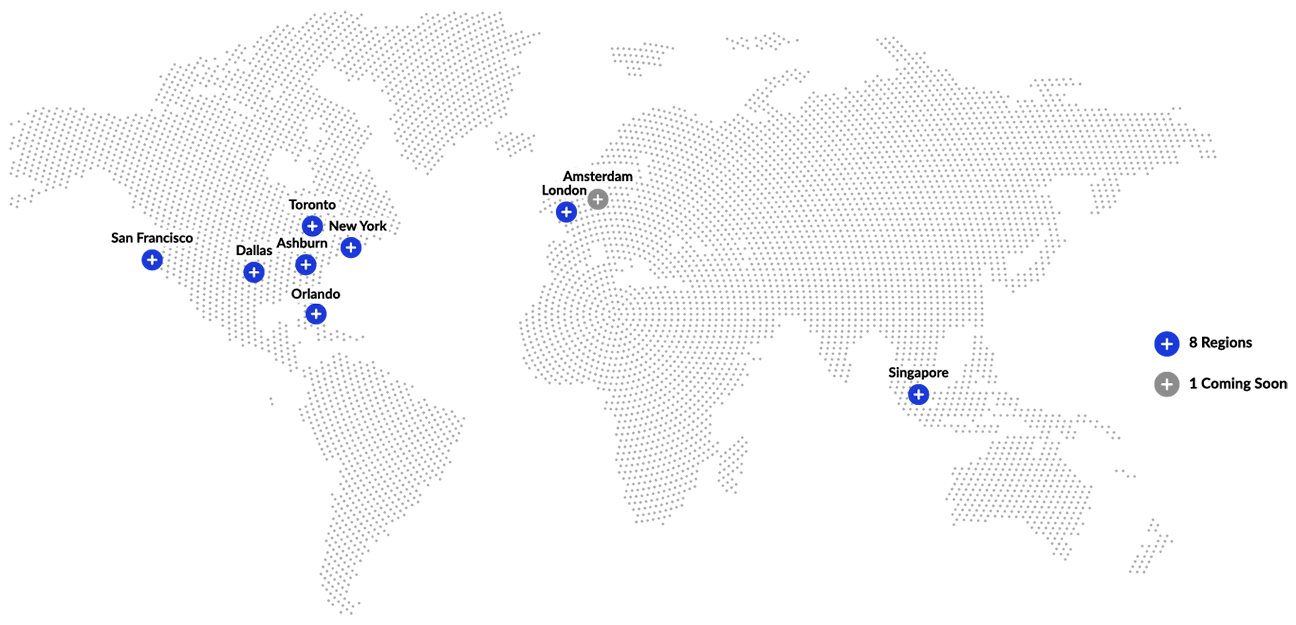
Deploy close to your users from eight international data centers worldwide, with new regions on the way.

Jason Coleman
VP of Information Technology, Orlando Magic
"After evaluating a range of managed hosting options to support our data operations, we chose Atlantic.Net because of their superior infrastructure and extensive technical knowledge."

Joseph Nompleggi
VP of Product Development, Complete Healthcare Solutions
"As our reliable Healthcare IT compliance partner for the past ten years, Atlantic.Net continues to deliver advanced IT architectural design and security guidance and support to CHS. With their flexible, customized solutions and high touch approach, we look forward to continuing to grow and work with this distinguished team of professionals."

Gilad Shainer
Senior Vice President of Networking, NVIDIA
(Formerly Vice President of Market Development at Mellanox Technologies)
"Leveraging InfiniBand's performance, efficiency and scalability capabilities, Atlantic.Net is able to provide its customers with a high-performance, reliable and scalable on-demand public cloud hosting platform."

Erin Chapple
General Manager for Windows Server, Microsoft Corp.
"Atlantic.Net's support for Windows Server Containers in their cloud platform brings additional choice and options for our joint customers in search of flexible and innovative cloud services."

From single servers to fully managed clusters, we'll help you build the ideal infrastructure for your business.
Call or email us now.
Contact an advisor at 866-618-DATA (3282), email sales@atlantic.net, or fill out the form below to get started.

Recognized with the 2026 Excellence in Customer Service Award from the Business Intelligence Group, Atlantic.Net is committed to delivering industry-leading support and an exceptional customer experience.