
New York
- Useful Proximity
- The Northeast corridor and financial-sector systems near Manhattan
Place cloud, dedicated, bare metal, and colocation infrastructure closer to your users, data, partners, and systems to shorten round-trip time and keep performance predictable under load.
Data Center Regions
8
Uptime SLA
100%
In many applications, the slowest part is the distance the data travels. Every request that crosses the country and back adds milliseconds, and those milliseconds add up across a checkout, an API call chain, a trading decision, or a video stream. Past a certain point, a faster server does not help; the path itself has to be shorter.
Atlantic.Net helps you shorten that path. We host on cloud, dedicated, and bare metal infrastructure, and on colocation, across data center regions in North America, Europe, and Asia, so you can place workloads closer to the people and systems that depend on them. The right choice depends on where your users are, where your data must live, and how traffic flows, so we start with the workload and wrap the infrastructure around it.
Low-latency hosting is infrastructure positioned and configured to reduce the round-trip time between an application and whoever, or whatever, talks to it: end users, partner systems, APIs, data sources, or other parts of the same platform. It combines two things: physical placement, putting the workload in a region close to its traffic, and a clean infrastructure design, dedicated resources, and private networking so performance stays predictable under load.
You choose a region near the traffic that matters most, so a single distant location does not serve everything. Atlantic.Net supports this across cloud servers, dedicated and bare-metal, and colocation, so you can fit the model to the workload.
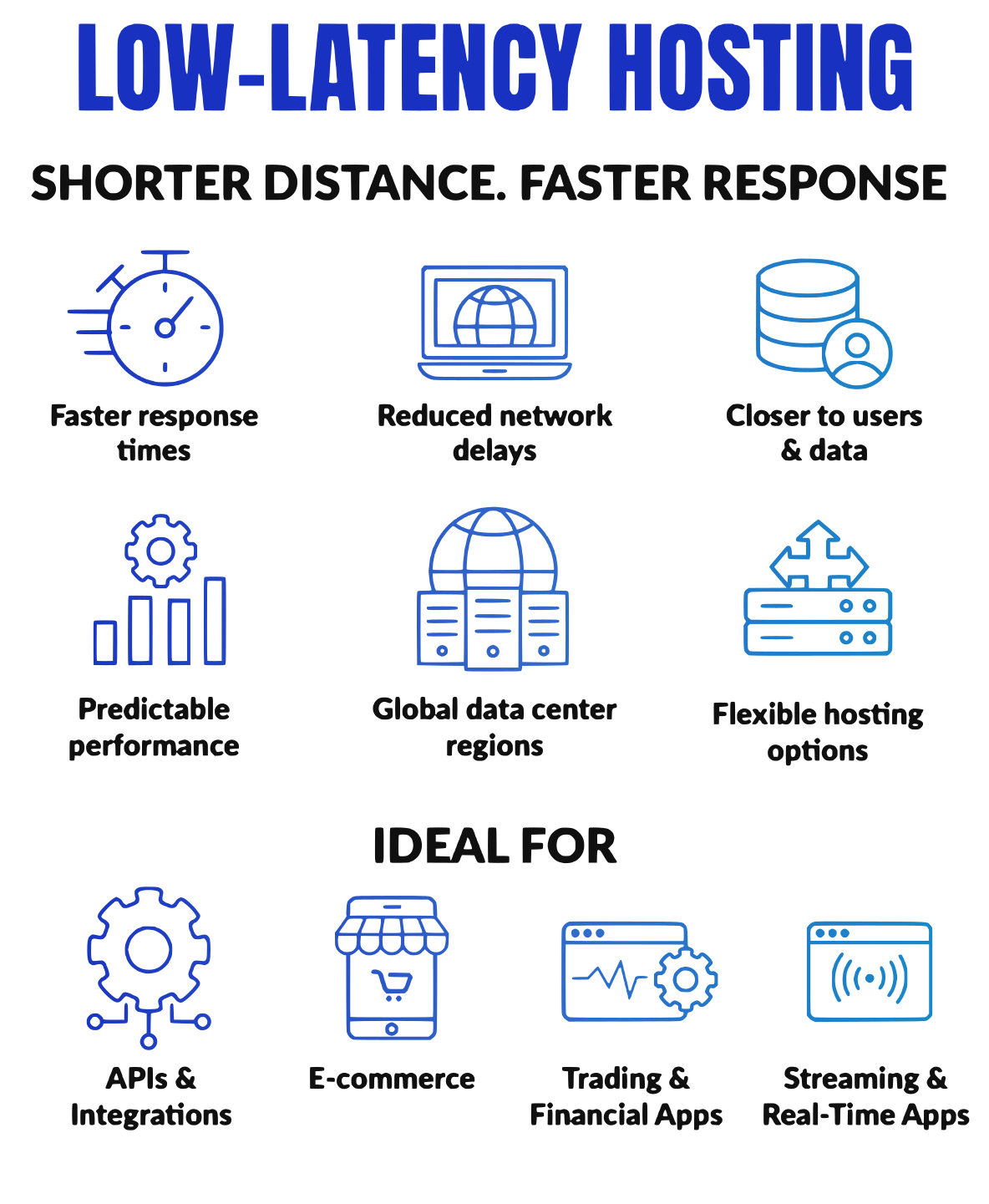
Latency comes from several places, and good placement addresses the largest one: physical distance. When you host near the traffic that matters, the gains are structural, not incremental tweaks.
place the workload in the region where most of your users are, so requests travel a shorter distance.
place the workload in the region where most of your users are, so requests travel a shorter distance.
keep compute resources near the data they process, which is especially important for noisy databases and analytics workloads.
keep compute resources near the data they process, which is especially important for noisy databases and analytics workloads.
position near the exchanges, APIs, or partner systems your application talks to most.
position near the exchanges, APIs, or partner systems your application talks to most.
connect your own tiers via private networking so traffic between them does not detour through the public internet.
connect your own tiers via private networking so traffic between them does not detour through the public internet.
The result is infrastructure designed to reduce latency for your specific traffic pattern. The exact numbers depend on your users, your routes, and your application, which is what an assessment works out.
Choose where each workload runs from data center regions across North America, Europe, and Asia. Placement is determined by workload, based on where your traffic concentrates and where your data must reside.
Choose where each workload runs from data center regions across North America, Europe, and Asia. Placement is determined by workload, based on where your traffic concentrates and where your data must reside.
Match the infrastructure model to the performance need: cloud for flexibility; dedicated and bare-metal for isolated, predictable performance; and colocation when you want to place your own hardware in our facilities.
Match the infrastructure model to the performance need: cloud for flexibility; dedicated and bare-metal for isolated, predictable performance; and colocation when you want to place your own hardware in our facilities.
Single-tenant cloud hosts and bare metal remove contention for CPU, memory, and disk, so response times stay steady even when a shared neighbor's load would otherwise cause them to fluctuate.
Single-tenant cloud hosts and bare metal remove contention for CPU, memory, and disk, so response times stay steady even when a shared neighbor's load would otherwise cause them to fluctuate.
Connect application, database, and cache tiers over private networking and VPC isolation, keeping internal traffic on a private path for both performance and security.
Connect application, database, and cache tiers over private networking and VPC isolation, keeping internal traffic on a private path for both performance and security.
For workloads that move a lot of data fast, dedicated servers support 10Gbps SFP+ and 25Gbps SFP28 uplinks, the networking used for high-throughput AdTech, real-time bidding, and trading-adjacent infrastructure.
For workloads that move a lot of data fast, dedicated servers support 10Gbps SFP+ and 25Gbps SFP28 uplinks, the networking used for high-throughput AdTech, real-time bidding, and trading-adjacent infrastructure.
Combine cloud flexibility with dedicated performance: a latency-sensitive tier on bare metal, elastic capacity on cloud, connected over private networking.
Combine cloud flexibility with dedicated performance: a latency-sensitive tier on bare metal, elastic capacity on cloud, connected over private networking.
For multi-region or unusual topologies, the team helps plan placement, routing, redundancy, and data residency before anything is deployed.
For multi-region or unusual topologies, the team helps plan placement, routing, redundancy, and data residency before anything is deployed.
Before go-live, Atlantic.Net engineers review the deployment against your performance goals and recommend adjustments to the region, model, and networking.
Before go-live, Atlantic.Net engineers review the deployment against your performance goals and recommend adjustments to the region, model, and networking.
Two decisions shape the outcome: which region, and which infrastructure model. Region is about the distance to your traffic; model is about how predictable the performance needs to be.
| Region | Useful Proximity |
|---|---|
| New York | The Northeast corridor and financial-sector systems near Manhattan |
| Ashburn, VA | Northern Virginia's dense interconnection and East Coast routing |
| Dallas, TX | Central US, balancing coast-to-coast reach |
| Orlando, FL | The Southeast US |
| San Francisco, CA | The West Coast and Silicon Valley |
| Toronto | Canadian users and data-residency needs |
| London | The UK and Western Europe |
| Singapore | Southeast Asia and the wider APAC region |
On the model: choose cloud for flexible, fast-scaling workloads; dedicated or bare metal when you need isolated, consistent performance; and colocation when you want to run your own hardware in a well-connected facility. Many performance-sensitive deployments combine a region close to users with dedicated resources to ensure predictability.
Placing workloads near their traffic shortens the longest part of many requests. Applications feel faster to the users and systems that matter most.
Placing workloads near their traffic shortens the longest part of many requests. Applications feel faster to the users and systems that matter most.
Per-workload region selection lets you balance performance against data residency and routing requirements, so a single location no longer has to serve everything.
Per-workload region selection lets you balance performance against data residency and routing requirements, so a single location no longer has to serve everything.
Dedicated resources and private networking keep response times steady as traffic climbs, so performance does not degrade at the exact moment it matters.
Dedicated resources and private networking keep response times steady as traffic climbs, so performance does not degrade at the exact moment it matters.
Start in one region and expand to others, or shift from cloud to dedicated, as traffic grows. The architecture is planned so that growth does not mean a rebuild.
Start in one region and expand to others, or shift from cloud to dedicated, as traffic grows. The architecture is planned so that growth does not mean a rebuild.
| Workload | Why Proximity Helps |
|---|---|
| SaaS platforms and APIs | Faster response for users and the systems calling your endpoints. |
| E-commerce stores | Quicker page loads and checkout for a concentrated user base. |
| Media and streaming | Lower start-up delay and steadier delivery for nearby viewers. |
| Gaming-adjacent services | Reduced round-trip times for matchmaking, state, and session services. |
| AdTech and real-time bidding | High-throughput networking near exchanges for faster bid cycles. |
| Analytics and data processing | Compute is placed near the data it reads, reducing transfer time. |
| Healthcare applications | Regional placement with data residency inside HIPAA-ready environments. |
Atlantic.Net has operated data center infrastructure since 1994 and runs performance-sensitive workloads, from high-traffic sites to trading-adjacent systems, on the same audited platform.
under one provider.
under one provider.
hardware, and power.
hardware, and power.
by phone, email, and chat, never outsourced.
by phone, email, and chat, never outsourced.
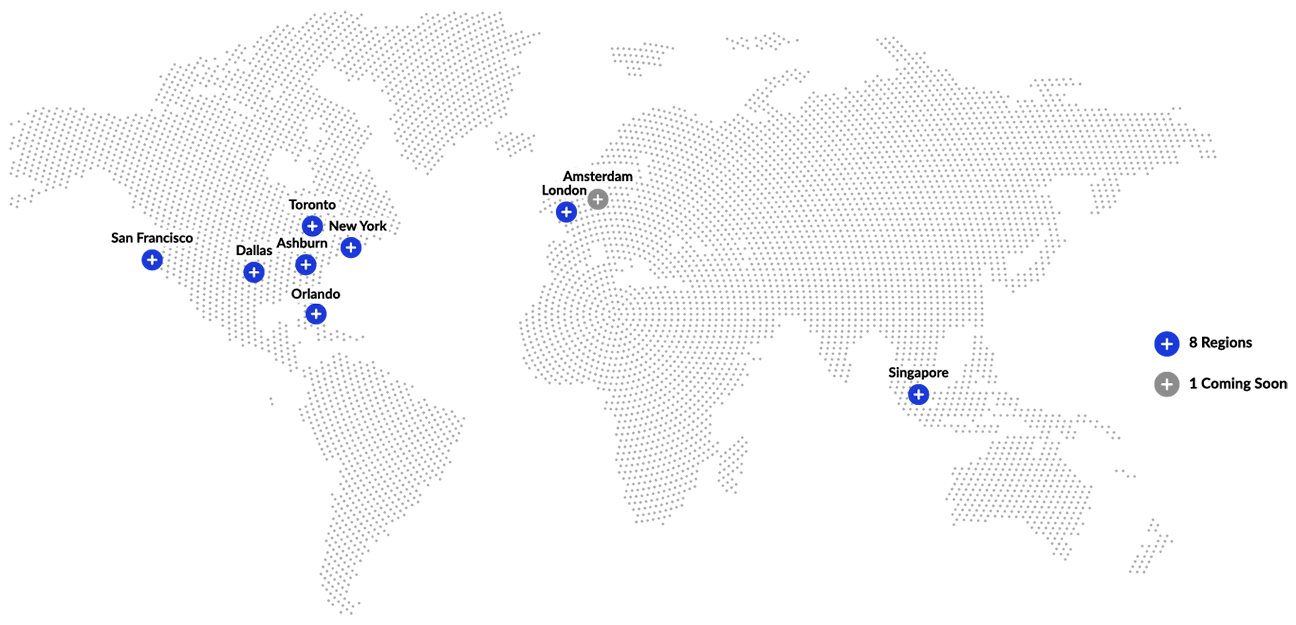
including New York, Ashburn, Dallas, Orlando, San Francisco, Toronto, London, and Singapore.
including New York, Ashburn, Dallas, Orlando, San Francisco, Toronto, London, and Singapore.
audited environments.
audited environments.
32 years operating network infrastructure.
32 years operating network infrastructure.
Deploy close to your users from eight international data centers worldwide, with new regions on the way.

Jason Coleman
VP of Information Technology, Orlando Magic
"After evaluating a range of managed hosting options to support our data operations, we chose Atlantic.Net because of their superior infrastructure and extensive technical knowledge."

Joseph Nompleggi
VP of Product Development, Complete Healthcare Solutions
"As our reliable Healthcare IT compliance partner for the past ten years, Atlantic.Net continues to deliver advanced IT architectural design and security guidance and support to CHS. With their flexible, customized solutions and high touch approach, we look forward to continuing to grow and work with this distinguished team of professionals."

Gilad Shainer
Senior Vice President of Networking, NVIDIA
(Formerly Vice President of Market Development at Mellanox Technologies)
"Leveraging InfiniBand's performance, efficiency and scalability capabilities, Atlantic.Net is able to provide its customers with a high-performance, reliable and scalable on-demand public cloud hosting platform."

Erin Chapple
General Manager for Windows Server, Microsoft Corp.
"Atlantic.Net's support for Windows Server Containers in their cloud platform brings additional choice and options for our joint customers in search of flexible and innovative cloud services."

From single servers to fully managed clusters, we'll help you build the ideal infrastructure for your business.
Call or email us now.
Contact an advisor at 866-618-DATA (3282), email sales@atlantic.net, or fill out the form below to get started.

Recognized with the 2026 Excellence in Customer Service Award from the Business Intelligence Group, Atlantic.Net is committed to delivering industry-leading support and an exceptional customer experience.