

Some workloads are defined by compute. Others are defined by how much data they hold and how fast they need to read and write it. Backup repositories, large databases, media libraries, log and analytics stores, and compliance archives all grow steadily, and a general-purpose server runs out of disk long before it runs out of CPU.
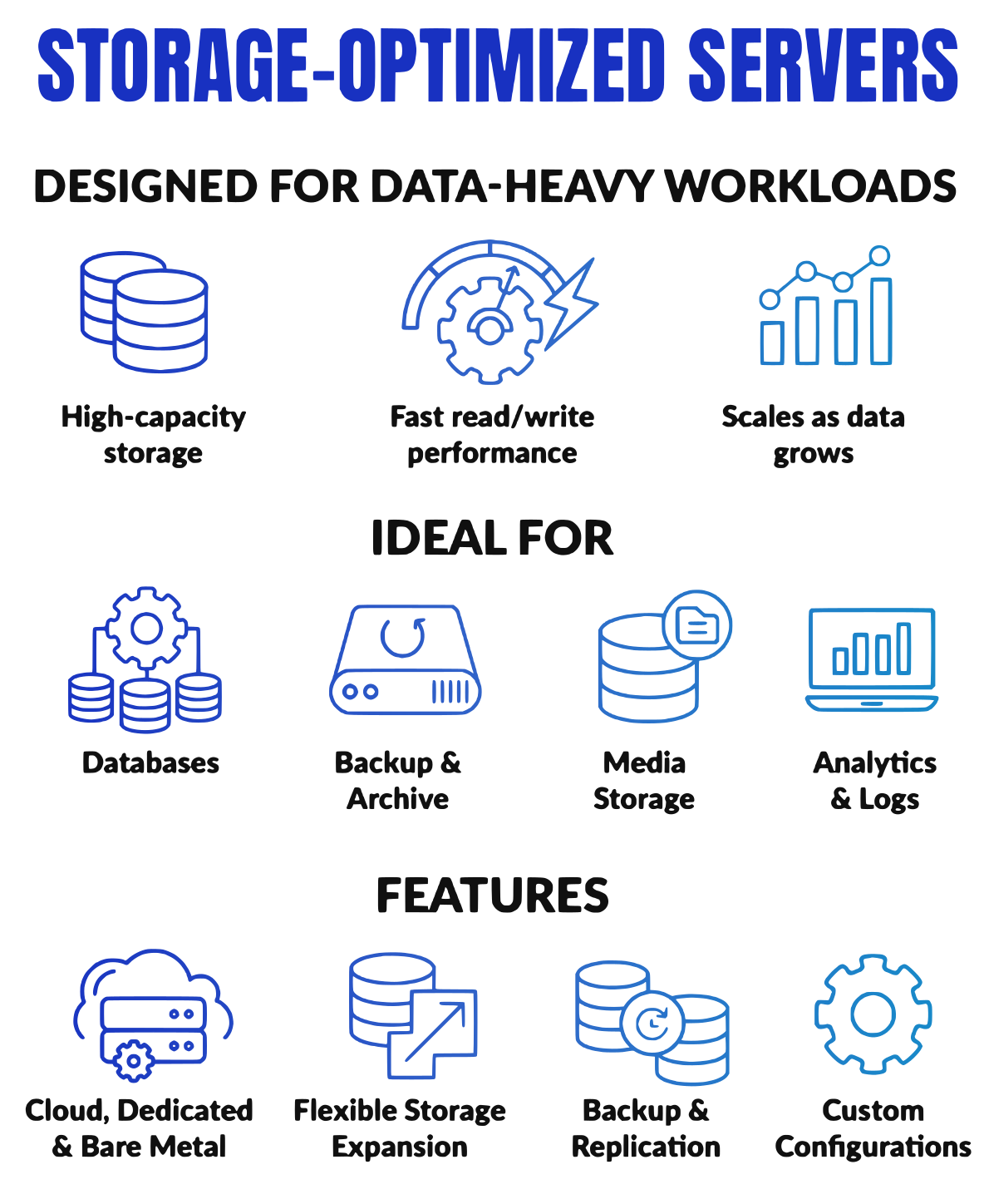
Atlantic.Net builds storage-optimized servers for exactly those workloads. You choose the balance of CPU, memory, and disk on dedicated or bare-metal hardware or on a cloud platform, and add block storage, backups, replication, and managed services as the data set grows. Capacity is sized to the workload, so the configuration follows the data, and custom builds are scoped directly with our team.
What Is a Storage-Optimized Server?
A storage-optimized server is infrastructure weighted toward capacity and disk throughput, with right-sized CPU and memory paired with high-capacity, high-performance storage, so the cost and the configuration follow the data. The disk leads the design, and the processor is matched to it.
Atlantic.Net offers storage-optimized infrastructure in several forms: Storage Optimized cloud servers (the S2 line, scaling to 16 vCPUs, 128GB RAM, and 4TB of SSD per instance), Fortress dedicated and bare metal servers with custom storage configurations and up to 1TB of ECC RAM, and Secure Block Storage volumes that attach elastic, replication-enabled capacity to either. You can run one of these on its own or combine them into a hybrid design.